Dundale Shopping Centre
Noughts & CrossesDundale Shopping Centre is both a public setting and the pivotal site of a bombing that reshapes the lives of Callum and Sephy. Its alarms, exits, and closed-circuit cameras become part of a sequence in which Callum tries to get Sephy to safety, an explosion kills at least seven people, and later authorities use the centre’s footage in court. The event binds a personal act of warning to a public narrative of political violence, with consequences that extend from the centre to Hewmett Prison.
A Public Space Under Pressure
The centre enters the story first as a place where the Liberation Militia is planning an operation. Callum realizes that Jude knows about what is being planned and does not want him involved; recalling that Sephy is at the shopping centre, Callum understands the danger and reacts with horror. The centre’s ordinary social life, including the café where Sephy is present, is thus set against a threat whose full scale Callum has only just grasped.
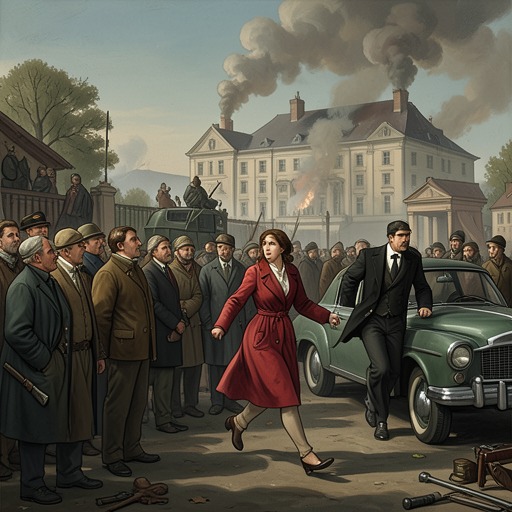
In the café, Callum drags Sephy out and along the concourse. When a stranger asks whether the boy is troubling her, Sephy calls Callum her friend and says that he wants to show her something. Her reassurance briefly makes their urgent departure look like an ordinary interaction to an onlooker, while the alarms soon make clear that something is wrong. Callum insists that they keep moving even as Sephy tries to stop and question him.
The Bombing and Escape
A flash and a massive explosion strike as Callum and Sephy are trying to leave. The blast throws Sephy down; after a dazed interval, she turns and sees smoke pouring from the shopping centre. The first pause gives way to screams and sirens. Callum lies stunned beside her. The scene’s abrupt shift—from an alarm and hurried movement to a blast, then to the sounds of emergency and panic—makes the centre a threshold between everyday space and catastrophe.
A news report soon describes Dundale as world-famous and announces that at least seven people have been killed outright, with scores more wounded. Casualties are being transported by ground and air ambulances, and hospitals in the immediate area are on full alert. The report says a warning from a group calling itself the Liberation Militia arrived only five minutes before the bomb exploded. Jude, hearing the broadcast, calls that account a lie. The centre is therefore not only the scene of mass casualties but the origin of a disputed explanation of responsibility.
Footage, Testimony, and Blame
The centre’s closed-circuit television becomes crucial evidence at Ryan McGregor’s trial. When the prosecution presents exhibit D19, footage assembled from cameras inside the shopping centre, Callum sees that it will show what happened. The recording captures him leaving the café and pulling Sephy with him. Although it has no audible dialogue, his actions appear directed toward getting her out: she looks around when the alarm sounds, and he pulls her toward the nearest exit before they run.
The tape then advances by several minutes. Without warning, a white flash appears from the café and the image goes dark. The sudden end leaves the courtroom with a stark visual sequence: Callum and Sephy flee, then the blast registers on camera. The recording does not contain their conversation, but it gives the court evidence of Callum’s conduct immediately before the explosion. Its force lies in the contrast between the visible attempt to escape and the prosecution’s accusation that the McGregor family knew about the bombing.
Consequences and Narrative Significance
The court’s use of the centre’s footage is part of a wider chain of consequences. Ryan is convicted of seven counts of murder and political terrorism and is sentenced to death by hanging. At his execution at Hewmett Prison, Callum and Sephy see one another across a gathering of grieving and angry mourners. Ryan’s sentence is later reprieved, but a news report states that he dies after trying to escape from prison by climbing its electrified fence. The report identifies him as the convicted Dundale bomber and says his family is devastated.
Dundale consequently connects an individual act of protection with an event whose political and judicial meanings overwhelm it. Callum’s actions on the centre’s cameras show him trying to get Sephy away from danger, while the bombing’s reported death toll and the accusation against the Liberation Militia place the same location at the heart of a national crisis. Later coverage and courtroom replay turn the shopping centre into a source of public claims and legal judgment; the place where the blast occurred continues to shape the story long after the smoke has cleared.